
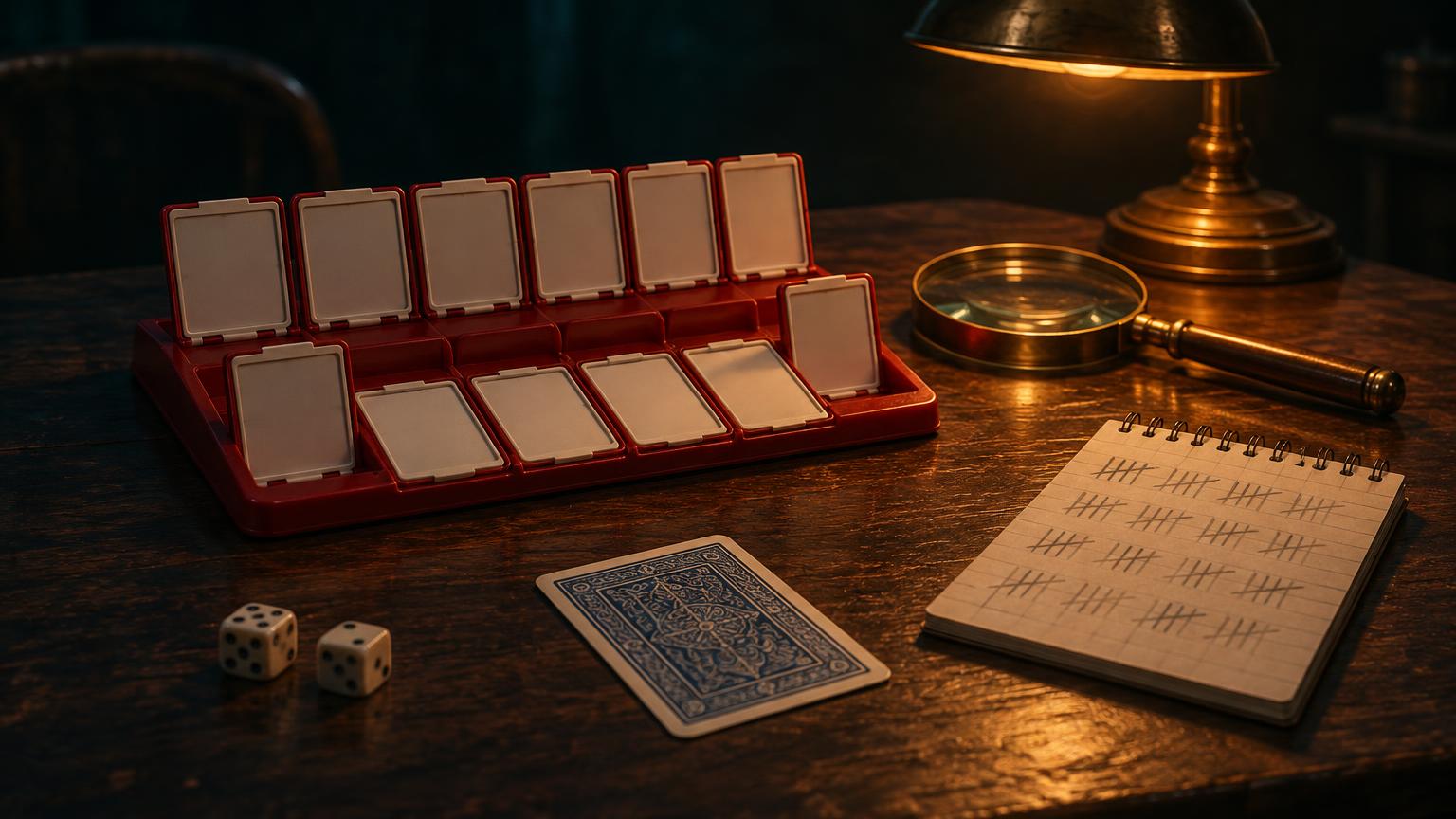
Two players, 24 faces, one question per turn. If both of you play perfectly, who wins?
Not the better bluffer, and not a coin toss either. In 2021 a mathematician at the Australian National University, Ben O'Neill, worked it out for the real board. The player who goes first wins about 56 games in every 100.
What the box says
The game was designed by Theora Designs and first made by Milton Bradley in 1979. The instruction sheet is short. Each player picks a mystery card, then you take turns asking one question that can be answered yes or no, flipping down every face that no longer fits.
On your turn you can ask a question or you can guess, but not both. A right guess wins. A wrong guess loses on the spot. And the younger player always goes first.
In the card version you can also cross off your own mystery person, because your opponent has a different one. So a real game starts at 23 faces against 23, and each player can see how many faces the other still has standing.
Six points for going first
If both players are perfect, O'Neill found, the first player wins 55.95% of the time. That is a small edge, but a real one. He points out that the younger-player-first rule hands the opening move to the person most likely to waste it.
Why so small? Because a guess costs a turn. You can narrow things down to one face and still have to spend your next turn naming it. Play the friendlier house version, where a wrong guess doesn't lose, and the game speeds up. The first player's edge grows to 65.97%.
For a fair game, O'Neill's fix is to let the second player flip down seven wrong faces before the first question. The board then starts at 23 against 16.
Why not just halve?
The usual advice is to ask questions that split the faces as close to half as you can. Glasses? Hat? That is the "split-in-half" method, and it gives you the fewest questions on average. Seven habits for mystery and guessing games covers the idea.
But Guess Who? is not a contest to use the fewest questions. It is a race against another person. Small children ask "Are you John?" about a single face. Older children learn to ask questions that wipe out many at once. Most adults stop there. The maths does not.
Programmer Joe Kelley showed why in a 2020 blog post. Picture yourself with 16 faces left while your opponent is down to two. They will win within one or two turns. Halve, and you reach 8 and then 4, far too slowly. Name a single face and you at least have a chance of winning on the spot. In his version of the game, where a wrong guess simply removes that face, the best odds he found from that position are 3 in 32, about 9 in 100. Slim, but halving all but guarantees a loss.
Mihai Nica proved the general case in a paper published in 2016. When you are level or ahead, halving is right. When you trail, the best play is a bold gamble that has a low chance of working but keeps you in the race. In his version, where narrowing to one face wins at once, the first player wins between 62.5% and 66.7% of games, depending on how many faces you start with. A fair start, he worked out, would give the first player a third to a half more faces to search.
When to stop being careful
Keep an eye on the other board. The number of flipped faces is public, and it tells you when the careful play stops working.
O'Neill's analysis of the friendlier version says to split in half until your opponent has only one or two faces left, and then to guess a single face. The official rules have the same logic at the extreme. If your opponent is down to one face, they will win on their next turn, so you may as well spend yours on a guess.
Not quite half
In 2025 a team of five, including two mathematicians from the University of Manchester, solved the game under the official rules. Their result holds a surprise. Halving is not always best: with six faces left, a question about two faces is one of the best moves, not a question about three.
There are even three odd cases where their usual formula breaks down. When each of you has four faces left, for example, the best move is to ask about a single named face.
The same team points out a trick the box does not allow. Ask a question with a paradox built in, one with no honest yes or no answer for some faces, and you can split the board three ways instead of two. They say it improves your chances significantly. They also joke that your opponent's head would explode.
At the table
- Split the faces close to half while you are level or ahead.
- Count the other board's flipped faces every turn.
- Once your opponent is down to one face, stop asking and guess.
- Going second? You start about six points behind. Splitting evenly is still the best opening.
A Daily Case works the same way: a handful of suspects, and you decide which question to spend first.
Sources
- Hasbro (Milton Bradley), Guess Who? instruction sheet (1987, 1996)
- Ben O'Neill, "Optimal guessing in 'Guess Who'", PLOS ONE (2021)
- Mihai Nica, "Optimal Strategy in 'Guess Who?': Beyond Binary Search", arXiv preprint (2016)
- David Cushing, Stuart Gipp, Ezra Levick, Em Rickinson and David I. Stewart, "Optimal Play in Guess Who", arXiv (2025)
- Joe Kelley, "Optimal Guess Who", blog post (2020)